Build new software products that matter.
Founders and technology leaders bring Danubio in for new products and major greenfield builds where the engineering has to be right from the beginning.
Best fit for
A founder with a product to build
When the vision is clear and the engineering has to be right from the first commit.
A team adding a product to the lineup
When an established company is building a new product or business line, without touching the existing one.
A bet that has to be right the first time
When a launch has a date, a market window, or customers waiting, and a rewrite later is not an option.
We are most often brought in by funded startups, scale-ups, and product-led companies building software that needs to hold up.
New products. Real engineering.
The proof: products Danubio took from the first commit to something real users rely on.
Working with Danubio was like having a world-class technical co-founder on our team. They crafted a beautiful product that our users loved. The fact that we went from a concept on paper to an acquisition in just 18 months says it all.


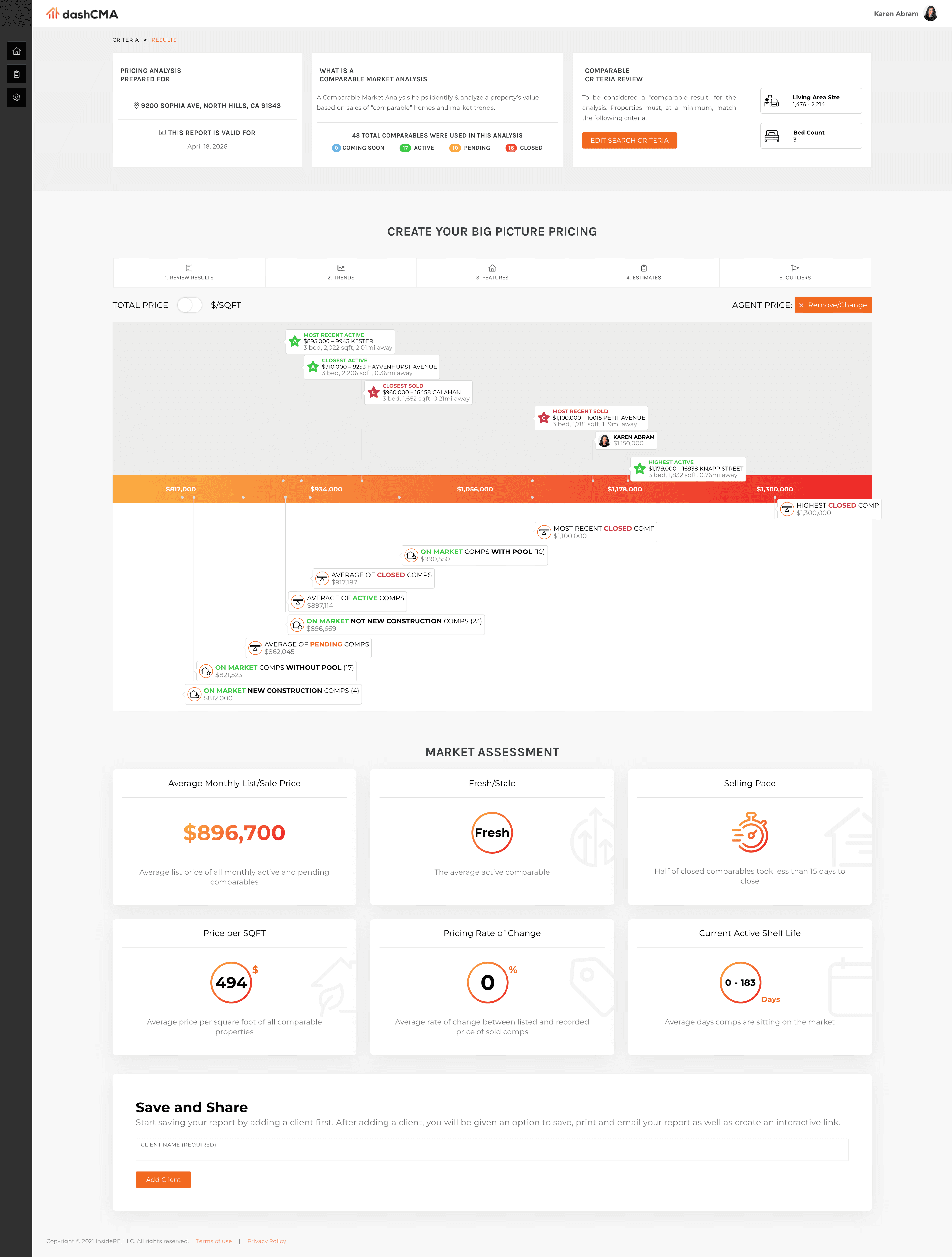
dashCMA, from concept to acquisition in 18 months
A founder came to Danubio with a clear product idea and the energy to ship it. Danubio built dashCMA from a blank repo into a real estate analytics product agents paid for and used every day. The work covered design, product engineering end to end, and the engineering decisions that made the product ready for due diligence when the acquisition conversation started.
Product engineering from day one, frontend and backend architecture, data and analytics pipeline, integrations, infrastructure, and the technical foundations the acquirer reviewed during diligence
A solo founder with no internal engineering team, a market that rewarded speed but punished sloppy software, and a product that had to look and feel like it had been built by a much larger team
HomeSearch AI was the most consequential launch of our year, and the engineering had to hit a date our customers had already heard. Danubio took ownership of it across BoldTrail and CORE Home, scaled the team for the push, and delivered on the date we had committed to. After years of running engineering alongside us, we knew this one would land.


I ran a web development consultancy for 11+ years, so I'm familiar with the trials and tribulations that can strike a project at any time. I can say, without a doubt, that Danubio will help you deal with any issue that comes up, and the one thing you won't have to worry about is that issue being with your developer. They're rock solid.

Strong engineering early. Outcomes the market validates. Continuity long after launch.
Danubio is built to bring senior technical judgment from day one, ship products that earn external recognition, and stay close to the product as it grows.
Strong engineering from day one
The early decisions shape everything that follows. Danubio brings senior technical judgment to architecture, system boundaries, and the implementation choices that decide what the next year of work feels like.
This was a genuinely hard problem: real-time scoring on top of a CRM we couldn't modify. Danubio came up with an elegant solution, and it worked so well that our internal teams have used the same pattern on other initiatives since. Real credit to them.

Outcomes the market validates
When the engineering is right, external signals follow. Reviewers cover the product, customers stay with it, acquirers pay attention. The clearest sign that the build held up is what happens next to a product Danubio helped launch.
"Compelling." "Fun to use."
- Inman Innovator Award nomination
- Acquired by Inside Real Estate (2020)
- Product evolved into CORE Present, retained by 350K+ agents nationwide
Continuity long after launch.
Products do not stop after launch. The engineers who learn the product stay close to it, which leads to better software, faster decisions, and stronger progress through the next phases.
Danubio built the original dashCMA with me, and they've kept building every chapter since: the acquisition, the integration, the enterprise rollout, the years of scaling. Having the same engineering team the whole way through is what made it work.
What does Danubio build for a new product?
Danubio takes on customer-facing applications, mobile experiences, backend systems and integrations, and the platform foundations a new product needs to land in a real environment.
Web product engineering
Customer-facing web applications, internal platforms, dashboards, and multi-tenant product experiences built for real use.
See related case studiesMobile product engineering
Cross-platform mobile products and companion applications that need to feel reliable, performant, and well integrated with the rest of the system.
See related case studiesBackend/Systems architecture
APIs, integrations, data flows, and the backend systems that shape how the product actually behaves.
See related case studiesPlatform foundations and integrations
Multi-tenant SaaS foundations, workflow-heavy B2B systems, and the integrations a new product needs to land in a real environment.
See related case studiesTwo ways teams usually work with Danubio.
Engagements at Danubio take one of two shapes. The first is a focused project where both sides see how the partnership runs. The second is the long-term engagement it grows into.
Project Delivery
Where a new product begins. Whether it's a founder's first build, a new product inside an established company, or a launch with a date that cannot move, the work starts with senior engineering ownership from the first commit.
Explore Project DeliveryOngoing Engineering Partnership
When the first build lands, the team stays on to grow the product. The engineers who made the early architecture decisions are the ones who extend them, so the product gains scope while the context behind it stays in the room. The same people stay with the code, year after year.
Explore Ongoing Engineering PartnershipNew products usually arrive through one of these doors.
Where a build lands depends on the surface and the engineering shape. The same senior ownership runs across all three.
A few common questions
How early in product direction can we bring Danubio in?
You can bring Danubio in as soon as the product direction is serious enough to drive engineering decisions, which is usually earlier than teams expect. Danubio does not own product strategy, that stays with you, but it helps shape the architecture, the scope tradeoffs, and the delivery plan that turn a product direction into something buildable and fundable. Coming in early is where the highest-leverage decisions get made: what to build first to validate the idea, what to defer, and which technical choices would be expensive to reverse later. On dashCMA, Danubio was the engineering team from the early product shape onward, and that early involvement is part of how the product went from idea to acquisition in eighteen months. The earlier the engineering view joins, the fewer costly course corrections later.
Do you work with founders and CTOs directly?
Yes. Most new-product engagements run with a founder, CTO, or head of engineering as the primary collaborator, and the working relationship is direct: the people making product decisions talk to the senior engineers building the product, with no account-manager layer in between. That directness is deliberate, because in a new build the important decisions, scope tradeoffs, architecture calls, and what ships first, happen fast and need a tight loop between intent and implementation. Communication moves at the speed the build needs, and the engineers carry enough product context to flag when a technical reality should change a product decision. For a founder, it means the person who understands the codebase is also in the room when the direction is set.
Can the first version be an MVP and still hold up later?
Yes, and that balance is the goal of most new-product engagements. A first version should be fast to ship and good enough to validate the idea with real users, while the architecture, data model, and core technical decisions underneath it are chosen so the next phase does not require a rewrite. The skill is knowing which corners are safe to cut for speed and which ones will be expensive to undo, then cutting the first kind freely and protecting the second. A throwaway prototype and an over-engineered platform are both common ways new products stall; the useful target is a lean version built on decisions that still hold when usage grows. dashCMA started as an early product and reached acquisition on a foundation that held up under that scrutiny.
Can Danubio work alongside our existing engineering team?
Yes. Many new-product builds run with Danubio engineers joining your existing workflows, tools, repositories, and day-to-day delivery, working alongside an internal team. In practice that means shared standups, pull requests into your codebase, the same review and deployment process, and ownership boundaries agreed up front so it is clear who owns which part of the build. The model adapts to how your team already works, so you add senior engineering capacity to a new product without taking on a separate vendor process or a parallel codebase. This works whether Danubio leads the build with your team supporting, or your team leads and Danubio takes a defined, high-stakes slice such as the core architecture or a launch-critical feature.
How does scope evolve after launch?
The best new-product work comes from continuity, so scope usually evolves rather than ending at launch. An engagement often starts with a focused first scope, getting a real version into production, and then expands naturally as the product finds traction and the roadmap grows. The engineers who built the foundations stay close to the work, which means the context behind the early decisions carries forward into what comes next instead of being relearned by a new team each phase. That continuity is what lets a product keep moving quickly after launch, because the people extending it already understand why it is built the way it is. Many engagements grow from a first build into an ongoing engineering partnership as more of the product leans on the work.
How quickly can a team start?
A team can typically start within one to two weeks of an initial engagement, depending on scope, complexity, and team availability. Danubio staffs deliberately, matching specific senior engineers to the work, so the short lead time is about getting the right people close to the product quickly rather than filling seats with whoever is free. For a new product, that early window is often used to align on the first scope, the architecture direction, and the launch target, so the team starts building against a clear goal instead of discovering it mid-flight. If a build is urgent, the starting scope can be kept tight so meaningful production work begins quickly while the broader plan firms up in parallel.
Deeper on this work
Planning a new product or major build?
If you're planning a new product, an MVP that has to hold up past validation, or a major platform build, we can talk through it.