Ship AI features and workflow automation that matter.
Founders and technology leaders bring Danubio in for new AI features, copilots, ranking layers, and operational AI loops built for real users, real load, and real money.
Two surfaces. The same engineering discipline.
AI is rarely a feature on its own. It either sits in front of a user inside a product, or runs inside a workflow the user never sees.
In front of the user
Surfaces the user touches: a search that understands the question, a copilot that can finish the task, a summary that saves a long read, a ranking that puts the right thing first.
- Natural-language search inside an HR tool, knowledge base, or catalog
- Drafting and reply assist inside a CRM, email, or support tool
- Summaries inside long records: claims, contracts, charts, tickets
- Recommendations and ranking that reflect what users actually do
- Voice as a first-class input
In the operational loop
Decisions the system makes on its own: what to flag, what to extract, what to route, what to skip. The work that used to need a person on the other end.
- Document ingestion and structured extraction (invoices, intake forms, contracts)
- Ticket and case classification, routed to the right queue
- Anomaly, risk, or fraud signals that trigger review before human time is spent
- Prioritization across long backlogs: claims, approvals, candidates, leads
- Background enrichment that feeds downstream systems
One AI launch, two platforms, one engineering team.
The strongest answer to “can Danubio actually ship AI in production” is the work itself.
HomeSearch AI was the most consequential launch of our year, and the engineering had to hit a date our customers had already heard. Danubio took ownership of it across BoldTrail and CORE Home, scaled the team for the push, and delivered on the date we had committed to.


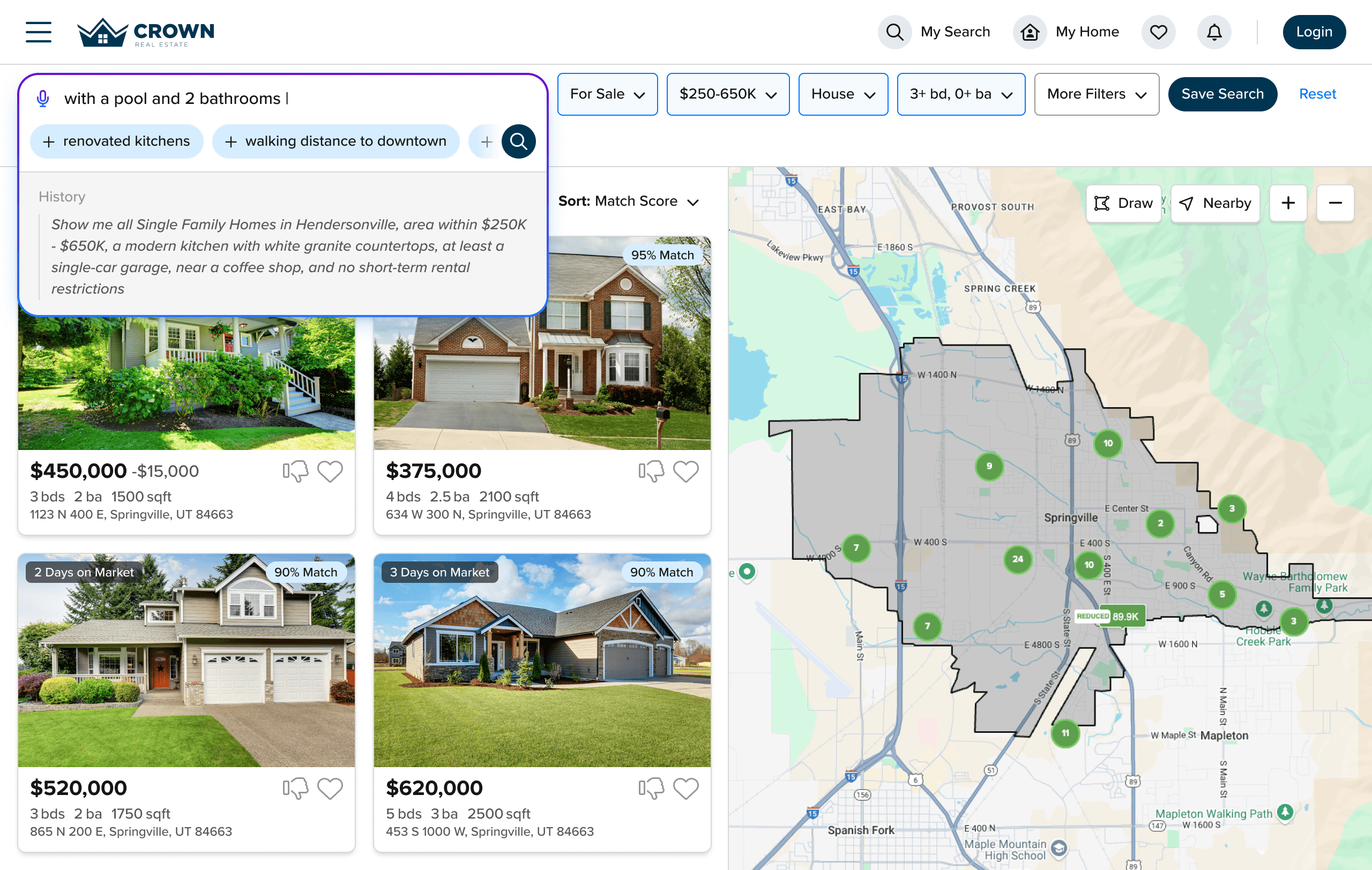
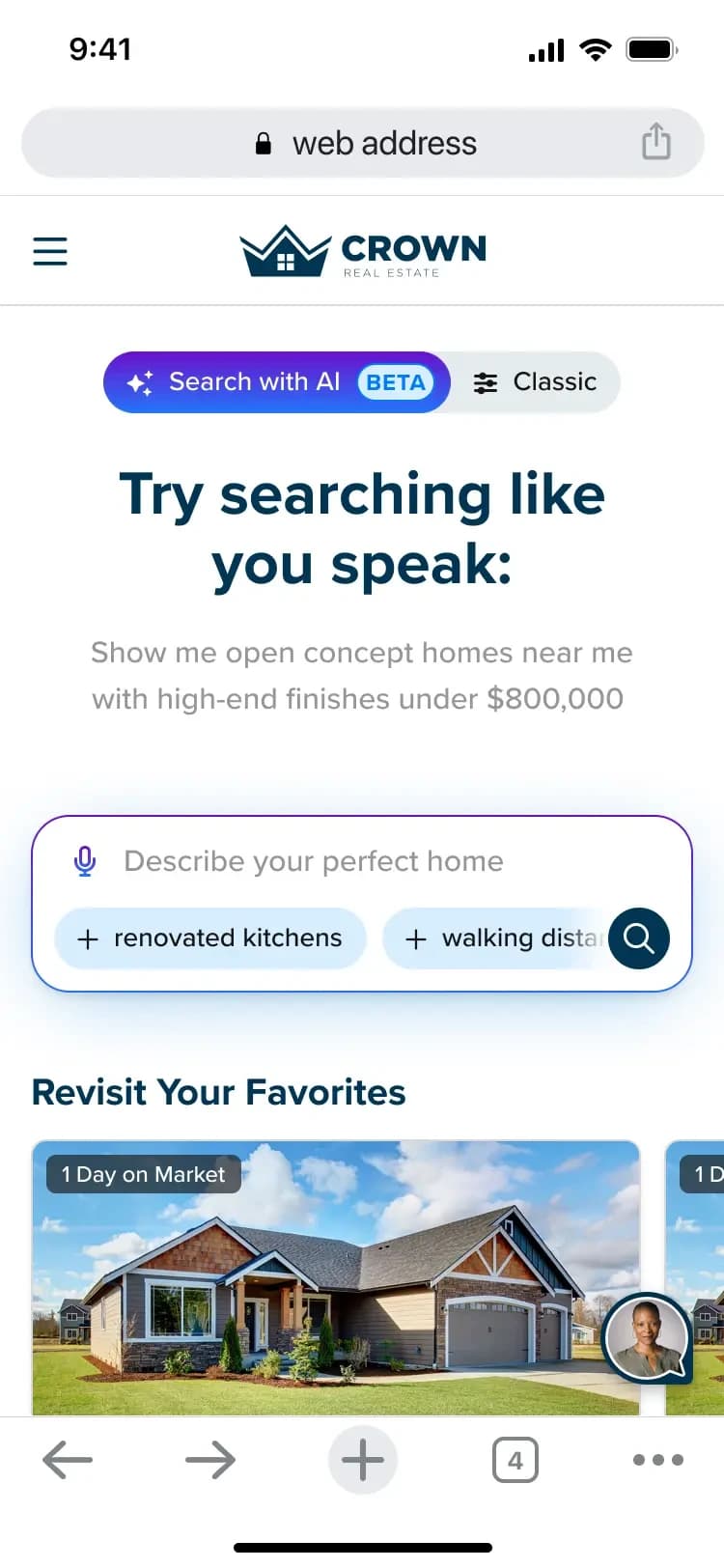
AI-powered property search, shipped to 400,000 agents in five months.
Inside Real Estate had committed publicly to launching an AI-powered home search across BoldTrail and CORE Home in five months. Promising models existed; the production search platform around them did not. Danubio became the engineering team behind the launch, owning the new search service, both product surfaces, and the alerting and reactivation loops on top.
Read case studyWhat “production” means in our work.
Four commitments we hold across every AI feature we ship, whether it sits in front of a user or inside an operational loop.
Latency budgets set against p99.
Model call latency varies wildly. We instrument latency by stage, stream responses where the surface allows, set timeouts to what the user can absorb, and route long-tail work to async pipelines.
Token cost as a first-class metric.
Cost per request instrumented from day one. Per-user and per-pipeline caps. Prompt caching where the provider supports it. Cheap models for simple work, expensive ones where they earn their weight.
Observability that includes the model.
Token counts, cost per request, latency by stage, cache hit rate, provider error rates, quality signals at the surface. The model sits in the trace, with the same depth as the rest of the system.
Failure modes designed in.
Timeouts with caps. Retries with caps. Schemas enforced on structured outputs. Bounded tool authority. Provider failovers where reproducibility matters. The integration absorbs the model going wrong without exposing the user.
Why teams bring Danubio in
Three lifecycle moments where the AI work is real, the engineering is the constraint, and senior judgment moves the needle most.
AI belongs in your product. You haven’t decided where.
There is board pressure or a market expectation, and the category is clear. What you need is a senior engineering partner who can survey the product, identify the highest-impact surface, and ship it inside a focused starting scope.
An AI initiative is on the roadmap, ahead of internal capacity.
Internal engineering is full, the AI work keeps moving down the queue, and leadership is starting to notice. The work is real, and it needs a senior partner who can own a meaningful workstream end to end while the rest of engineering keeps moving.
The POC works. Now it has to handle real users.
A POC handles the inputs it was tested on. Production has new inputs, higher traffic, partial failures, and a cost ceiling. The system around it has to be built.
Trusted on AI work where the engineering needs to hold up.
Trusted with critical work.
HomeSearch AI was Inside Real Estate's most consequential launch of 2025. CORE Home's multi-tenant rebuild had no margin for error. dashCMA went from concept to acquisition in 18 months. The engagements that fit our shape are the ones where the stakes are high and the work has to land on time.
Read the HomeSearch AI case studyBackend through mobile, one team.
AI features need integrations, data paths, alerting, observability, and the product surface around them. We carry all of it, with the same engineers across the stack rather than a handoff at every boundary.
Continuity.
AI features don't end at launch. Models drift, data shifts, the product moves. The engineers who shipped the first version stay with it, so the system keeps working as the ground underneath it changes.
How we turn AI into product.
A typical engagement runs through these phases. The shape adjusts to where the team actually starts.
Frame the production target.
Latency, fallbacks, cost ceiling, eval signal. The engineering follows from these.
Build the platform around the model.
The contract the product calls, the data path that grounds it, the pipeline, the integrations, the instrumentation.
Launch and instrument.
Production traffic, real eval, A/B and shadow paths so the model layer can keep moving, cost and capacity monitored from day one.
Stay close as it evolves.
Models change. Providers change. Prompts drift. The team that built it absorbs those changes without rewriting the product around it.
Two ways teams work with Danubio on AI.
An AI engagement usually starts as a focused first project, a senior-led team of 2 to 4 engineers over roughly 6 to 12 weeks, to get one capability into production, and grows into a long-term partnership as more of the product leans on it.
Project Delivery
Where an AI feature starts. A scoped first build that takes one capability, a copilot, a ranking layer, or an operational loop, from idea to running in production against real users and real load.
Explore Project DeliveryOngoing Engineering Partnership
Once the first feature runs in production, the team stays on to extend it: more surfaces, evaluation and monitoring, and the next capabilities, owned by the engineers who shipped the first one.
Explore Ongoing Engineering PartnershipWhere AI features land inside a product engagement.
AI work rarely arrives standalone. It lands inside a new product, an existing one being modernized, or as a surface inside a web product.
A few things we get asked
Do you help us figure out where AI fits, or do we need to come with a plan?
Either works. If you have already picked the surface, say a search experience, a copilot, or a ranking layer, Danubio goes straight to building it against a real production target. If you know the category but not the specific surface, Danubio surveys the product, identifies the highest-impact place to start, and delivers that inside a focused first scope. The work is always engineering framed around a concrete launch rather than an open-ended exploration, because an AI feature only proves its value once it is in front of real users. What Danubio brings to the where-does-AI-fit question is engineering judgment about what is actually shippable, reliable, and worth the cost, which is often the part that turns a promising idea into a launch instead of a demo.
Do you bring models or use ours?
Either. Danubio has shipped AI features on top of vendor APIs such as OpenAI and Anthropic, on self-hosted models running on client infrastructure, and on hybrid setups that mix the two. The choice is driven by the real constraints of the product: latency budgets, cost per request at expected volume, how much control and customization you need, data-residency and privacy requirements, and what the feature actually has to do. A vendor API is often the fastest path to a first launch; a self-hosted or fine-tuned model can win on cost, control, or data handling once the use case is proven. Danubio makes that call against your specific situation and is comfortable changing it as the product scales, since the right answer early is not always the right answer at volume.
What happens after the first launch?
After the first launch, the work shifts to learning from real usage. The first version teaches the team what the AI feature actually does in front of real users, which is information no amount of pre-launch planning produces: which queries people really send, where the model gets things wrong, and where the experience breaks down. The next version is built on that signal, with ranking tuned to actual queries, prompts iterated against real failures, A/B paths run to compare approaches, and edge cases handled as they surface. The team that shipped version one is the team that should ship version two, because the value compounds in the engineers who have seen how the feature behaves in production. AI features improve fastest when launch is treated as the start of the work.
What about hallucination and unsafe outputs?
Hallucination and unsafe outputs are handled by designing the integration to assume the model can be wrong, slow, or silent, rather than treating those as rare exceptions. In practice that means schemas enforced on any structured output so malformed responses are caught before they reach the product, tool calls bounded by exactly what the model is allowed to do, empty and error states that give the user a real next action, and human handoff at the edge of what the model may decide on its own. These guardrails are specified as part of the feature itself, before launch, so safety is a property of the design instead of a patch added after something goes wrong. For features that touch money, identity, or irreversible actions, the bounds are tighter and the model is given less unsupervised authority.
Can you work alongside our existing engineering team?
Yes. Many AI engagements run with Danubio engineers joining your internal engineering team: shared standups, a shared release cadence, and ownership boundaries agreed up front so it is clear who carries which part of the feature and the platform around it. Danubio adjusts to your stack and your delivery rhythm rather than imposing a separate process. This works as a first project, where Danubio leads the AI feature with your team supporting, and as part of longer engineering work, where your team leads and Danubio owns a defined slice such as the retrieval layer, the eval harness, or a latency-critical service. Because AI features sit on top of the wider product, working inside the existing team keeps the feature consistent with the system it lives in.
What does a starting engagement look like?
A starting AI engagement is a focused scope inside a real product surface, often a search experience, a copilot, a ranking layer, or an alert loop. It begins by framing the production target explicitly: the latency the feature has to hit, the fallbacks for when the model is wrong or unavailable, the cost ceiling per request, and the evaluation signal that will tell you whether it is working. The model and architecture choices follow from that target rather than leading it, which keeps the work anchored to a launch instead of a demo. HomeSearch AI is an example of this shape at scale, an AI-powered property search taken into production in five months. A first scope is deliberately bounded so it ships, proves value, and gives a foundation the next phase can build on.
Deeper on this work
Have an AI workflow that has to run in production?
If your product or operational system needs AI in the loop and the engineering needs to be done well, we can talk through it.