A custom back-office for a one-person training consultancy.
Adam Weisbart ran a global Scrum training practice as a sole operator. Danubio built him a custom console where calendars, students, finances, travel, and feedback all lived in one place. He used it daily from 2018 until he wound down the consultancy in 2023.
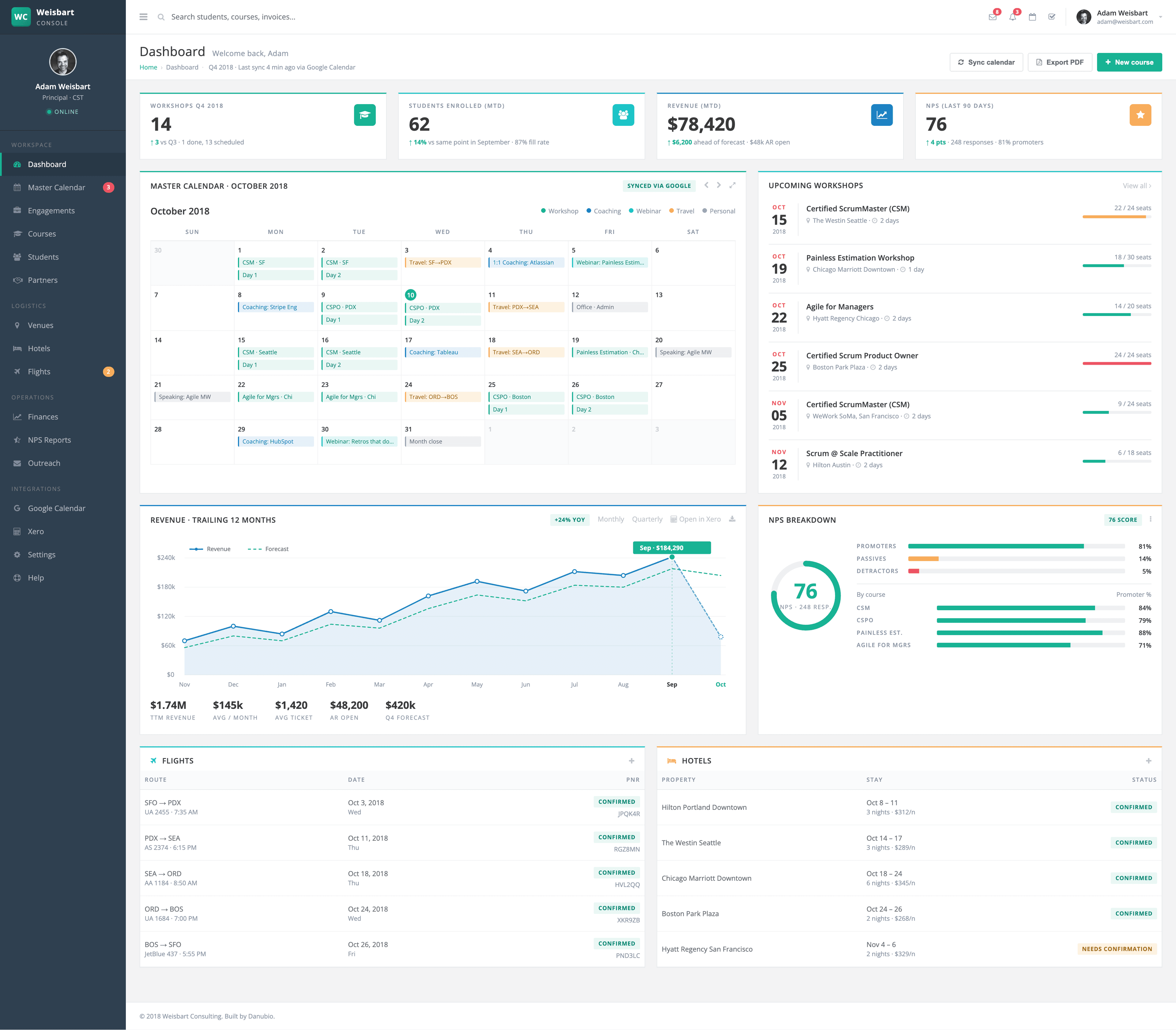
The morning view: master calendar synced from Google, course pipeline, financial pulse, and travel logistics on one page.
The situation
Adam Weisbart was a Certified Scrum Trainer running a global training practice from his desk. He delivered CSM, CSPO, and Painless Estimation workshops across cities every month, with all the operational work that comes with it: rosters, venues, hotels, flights, invoices, surveys, certificates, and follow-ups.
Off-the-shelf options didn’t fit. A general-purpose CRM wasn’t built for itinerant trainers. A learning platform didn’t know about hotel bookings or flight legs. Stitching together five SaaS subscriptions meant five logins, five sources of truth, and a constant reconciliation tax. Adam came to Danubio with a clear ask: a single console where everything lived, modeled around how he actually worked.
Each workshop owns its own page
Adam delivered the same workshop format dozens of times a year, in different cities, with different people. A CRM-style approach (students in one module, venues in another, invoices in a third) would have made his most common task, running one workshop, the most tedious.
We organized the system around the workshop itself. Each course instance has one page that owns its full lifecycle: roster, day-by-day agenda, venue and travel logistics, financial breakdown, post-course feedback, and the certificates and invoices that close it out.
Students stay known across years
Adam taught the same people more than once. Returning attendees moved from CSM to CSPO to advanced track work, sometimes years apart. Each course had a roster, but the practice as a whole had alumni, and the system needed to remember them across cohorts.
Each student has a profile that accumulates course history, payment history, NPS scores given, communications, and Adam’s private notes from prior sessions. When a familiar name appeared on a new roster, Adam had context.
The survey lives inside the system
Post-course feedback was central to Adam’s improvement loop. He wanted control over question design, branching logic, and how individual responses fed back into per-course NPS rollups. Renting a generic survey product would have meant a separate login, a separate database, and integration glue that always lagged.
We built the questionnaire builder into the console directly. Drag-and-drop question types, per-template versioning, recipient lists tied to course rosters, and responses that landed in the same database as everything else.
The hard part
Software for a single user is a different design problem than software for many. The user knows the system better than the people who built it. Edge cases get hit every week because they are part of how Adam works. Workflow assumptions cannot be papered over with options panels because there is no one else for those options to serve.
The integrations had to be quiet and reliable. Google Calendar drove the schedule. Xero owned the financial source of truth. The console sat in the middle, syncing both ways without ever showing Adam a sync failure message during a workshop. Certificate generation, invoice batching, and PDF exports ran on a cadence that matched his teaching weeks rather than a generic queue interval.
The system shipped in 2018 and ran in production until Adam wound down the consultancy in 2023. It was used every working day in between.
I ran a web development consultancy for 11+ years, so I'm familiar with the trials and tribulations that can strike a project at any time. Sometimes it's a technical issue, sometimes it's a timeline issue, sometimes it's a developer issue. I can say, without a doubt, that Danubio will help you deal with any issue that comes up, and the one thing you won't have to worry about is that issue being with your developer. They're rock solid.


Frequently asked questions
What did Danubio build for Weisbart Consulting?
Danubio built a custom back-office console for Weisbart Consulting that brought calendars, students, finances, travel, and feedback into one place for a sole operator running a global Scrum training practice. Instead of juggling separate tools and spreadsheets across scheduling, payments, travel logistics, and student feedback, Adam Weisbart had a single internal system tailored to exactly how his practice ran. The value of a custom tool here is fit: a one-person global operation has specific workflows that off-the-shelf products only partly cover, and a console built around those workflows removes the daily friction of stitching tools together. It was built on React and Laravel with PostgreSQL, the same engineering standard Danubio applies to larger products, scaled to what a single-operator business actually needed.
How long was the tool in use?
Adam Weisbart used the custom back-office console daily from 2018 to 2023, five years of continuous, day-to-day use running his global Scrum training practice. That longevity is the real measure of an internal tool: software that someone depends on every working day for five years has to be reliable, maintainable, and genuinely fitted to the work, or it gets abandoned for a workaround. The console held up as the operational backbone of the practice across that whole period. For a custom tool built for a single operator, five years of daily use is a strong signal that the engineering decisions, on a React and Laravel stack with PostgreSQL, were the right ones for the job.
Does Danubio take on smaller, single-operator projects?
Yes. Danubio takes on smaller, single-operator projects: the Weisbart Consulting engagement was a custom internal tool for a one-person consultancy, built on React and Laravel with PostgreSQL. What makes a project a fit is whether it is real software that benefits from being engineered well, regardless of its size, and a tool someone will rely on daily for years qualifies. Smaller engagements get the same senior engineering and the same standard for reliability and fit as larger ones; the scope is simply matched to what a single-operator business needs and can sustain. The Weisbart console, used every day from 2018 to 2023, is the example of how that works in practice.
Operations software that actually fits your workflow?
Danubio builds custom internal systems for operators and small teams whose work does not fit the SaaS shelves. Senior engineering, end-to-end ownership, built to be lived in.